
Pruning
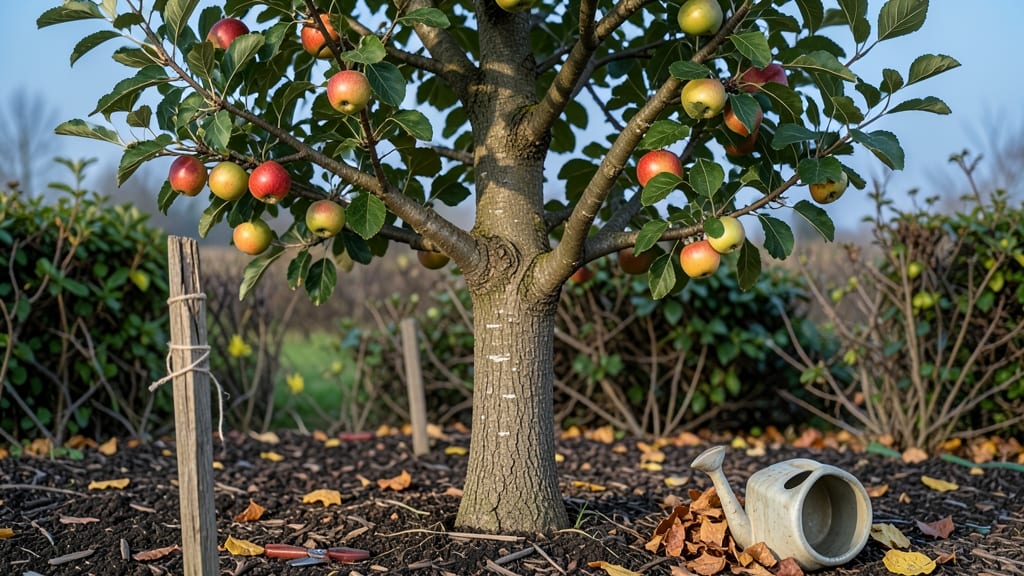
Mastering apple tree identification by leaf shape and bark texture saves you from costly pruning mistakes or disease misdiagnoses—like how Granny Smith leaves curve at the tips. edges while Fuji leaves stay flat. The right ID means you’ll prune correctly, fertilize properly, and even predict harvest times.
Start with the leaves: count the teeth along the edge (Granny Smith has 20+, Fuji around 15), then check the bark. Young apple bark is smooth and silvery, but mature trees develop plates or ridges that crabapples lack.
Bring a camera—some varieties, like Honeycrisp, have distinctive red blushes even before fruit sets.
Once you match the clues, you’ll know exactly how to care for your tree—whether it needs winter protection, specific pruning angles, or disease-resistant sprays. A misidentified tree could mean wasted effort or even death. Think of it as your first step toward a thriving orchard that produces fruit for decades.
This works year-round: use leaves in spring, bark in winter, and fruit shape in fall. Even if you’re just browsing nurseries, these tricks help you pick the perfect tree for your climate and space. Let’s get those trees identified right!
📚 In This Guide
- What you need
- Instructions
- Tips and common mistakes
- Wrapping up and next steps
What you need
- ● Hand Lens (Magnifying Glass) – A 10x magnification lens helps inspect fine details like bark texture and leaf veins.
- ● Notebook & Pencil – A small ruled notebook (or digital notes app) to jot down observations like leaf shape, bark color, and tree height.
- ● Measuring Tape – A 10-25 ft retractable tape to measure tree height, trunk diameter, and leaf dimensions.
- ○ Pruning Shears (Optional but Helpful) – Bypass shears (for clean cuts) to collect a few leaves or twigs for closer inspection.
- ● Camera or Smartphone – For capturing high-resolution photos of leaves, bark, and fruit (if available) for later comparison.
- ● Field Guide or Apple Tree ID App – A printed guide (like "The Tree Book" by Gilbert Vallee) or apps like "PictureThis" or "LeafSnap" for instant ID help.
- ○ Gloves (Optional but Recommended) – Nitrile or leather gardening gloves to protect hands from thorns or rough bark.
- ● Ruler or Leaf Measuring Tool – A 6-inch metal ruler for precise leaf length/width measurements.
- ● Plastic Bags or Envelopes – To preserve leaf samples if you’re comparing them later.
- ● Tree Identification Key – A dichotomous key (available online) for step-by-step ID based on your observations.
- ● Binoculars (for Tall Trees) – 8x42 magnification to inspect high branches safely.
How to identify apple trees using leaf and bark characteristics
Mastering these visual cues will let you recognize apple varieties in seconds—no heavy field guides needed.
Examine the Leaf Shape and Arrangement
Start by inspecting the leaves, which are the most distinctive feature for quick identification. Apple tree leaves are typically 4-7 inches long with a serrated (toothed) edge. Look for the elliptical to oval shape—most apple varieties share this basic form, but subtle differences appear in the leaf base and tip. Hold the leaf up to light to check for prominent veins that radiate from the central stem.
Here's the thing—leaf arrangement matters too. Apple tree leaves grow in a spiral pattern along the branch, with each leaf angled slightly upward. This alternate arrangement helps distinguish them from other fruit trees like cherries, which often have opposite leaf pairs. If you see leaves growing directly across from each other, it's not an apple tree.
Study the Bark Texture and Pattern
Bark provides the fastest clues for mature trees. Young apple trees have smooth, gray bark that develops horizontal lenticels (tiny raised pores) as they age. On older trees, look for the classic plated or scaly bark that peels in irregular patches. This texture is unique to apple trees and helps eliminate look-alikes like hawthorns or crabapples.
Pay attention to the color variations—apple bark often shifts from gray to brown with age, sometimes developing a slightly reddish tint. Run your hand along the trunk to feel the rough, ridged surface that forms as the tree matures. This tactile check is especially useful in winter when leaves are absent.
Check for Fruit and Flower Characteristics
When fruit is present, examine the apple shape and size—most varieties produce round to oblong fruits with a distinctive stem attachment. The calyx (flower remnant) at the top should have five small lobes, a key identifying feature. Compare the fruit's surface texture—some varieties are smooth, while others develop a fuzzy russeting pattern.
If no fruit is available, look for flower clusters. Apple blossoms appear in 5-petaled white to pink flowers that grow in flat-topped clusters. These flowers emerge before leaves in spring and have a sweet, honey-like fragrance. The presence of these clusters confirms you're dealing with an apple tree rather than a related species.
Verify with Branch and Twig Details
Inspect the branch structure for lateral branches that grow at sharp angles from the main trunk. Apple trees develop spurs—short, stubby branches with clusters of leaves and fruit—along their limbs. These spurs are a dead giveaway for apple trees and distinguish them from other fruit-bearing trees.
Look closely at the twigs. Young apple twigs are greenish-brown with hair-like lenticels along their length. As they mature, they develop a slightly zigzag pattern where leaves attach. This distinctive growth habit helps confirm your identification when other features are ambiguous.
Tips & tricks for perfect apple tree identification
These visual cues will help you spot apple trees with confidence—no guesswork required. Here's what nobody tells you about the subtle details that make all the difference.
Leaf Vein Insight: In Step 1, when checking for prominent veins radiating from the central stem, focus on how they branch. Apple tree veins typically create a pattern where smaller veins connect to the main vein at angles between 45-60 degrees. This "ladder-like" structure is a dead giveaway when compared to other fruit trees whose veins often run parallel. Hold the leaf up to natural light—you'll notice how the veins create a web-like network that's distinctly different from the simpler vein patterns of trees like pears or cherries.
Bark Texture Nuances: The scaly bark in Step 2 develops in predictable patterns. For younger trees, look for the lenticels (those tiny raised pores) to appear in horizontal rows along the trunk. As the tree matters, these lenticels become less visible as the bark develops its characteristic rough, ridged texture. Run your fingers along the trunk—apple bark should feel like coarse sandpaper, whereas similar trees like hawthorns develop smoother, more uniformly textured bark. This tactile difference is especially useful in winter when leaves aren't available.
Flower Cluster Clues: When examining the flat-topped clusters in Step 3, pay attention to how the flowers attach to the stem. Apple blossoms grow directly from the stem rather than on small stalks, creating a dense cluster appearance. Each flower should have five distinct petals arranged symmetrically, with the central stamens creating a star-like pattern when viewed from above. This precise arrangement helps distinguish apple blossoms from similar-looking flowers of crabapples, which often have more irregular petal shapes.
Twig Pattern Recognition: The slightly zigzag pattern mentioned in Step 4 becomes more pronounced as the tree ages. Look for these zigzags at the points where leaves attach—this is where the tree's growth hormones concentrate. Young twigs should have fine, hair-like lenticels that disappear as the twig matures. Compare this to other fruit trees: cherry twigs develop smoother, more uniformly shaped patterns, while pear twigs often have more pronounced knobs at the leaf attachment points.
Pro Tips for Apple Tree Identification
- These visual cues will help you spot apple trees with confidence—no guesswork required.
- Leaf Vein Insight: In Step 1, when checking for prominent veins radiating from the central stem, focus on how they branch.
- Bark Texture Nuances: The scaly bark in Step 2 develops in predictable patterns.
Frequently asked questions
Got questions about spotting apple trees in your yard or neighborhood? Here are answers to the most common queries—no green thumb required!
How can I tell an apple tree apart from a pear or crabapple tree?
Look for leaf shape and fruit clues! Apple leaves are oval with jagged edges, while pear leaves are more pointed and smooth-edged. Crabapples have smaller, tart fruit and often grow in clusters. Bark texture also helps—apple bark is smoother and less ridged than crabapple’s rough, scaly look.
What’s the best time of year to identify apple trees by their bark or leaves?
Spring and early summer are ideal! Leaves are fully grown by May, making shape and color easy to spot. For bark, late winter (before buds swell) or fall (after leaves drop) works best—this is when bark patterns are most visible. Avoid winter when bark may be obscured by snow or ice.
My tree has apple-like leaves but no fruit—could it still be an apple tree?
Maybe! Young apple trees (under 5 years) or non-fruiting varieties may skip fruit production. Check for bloom clusters in spring (small white/pink flowers) or seed clusters in fallen leaves. If none appear, it could be a ornamental crabapple or wild apple relative.
Are there apps or tools to help me ID apple trees for free?
Try the PictureThis or PlantNet apps—upload a photo of leaves/bark/fruit, and they’ll match it to your tree. For a DIY approach, carry a field guide (like “National Audubon Society Field Guide to North American Trees”) or use a magnifying glass to inspect bark texture up close.
My “apple tree” has holes in the leaves—is it still safe to eat the fruit?
Holes from leaf miners or aphids usually don’t harm fruit, but check for signs of pests like codling moths (tiny brown worms in apples) or apple maggots (white grubs inside). If you see webbed leaves or sticky residue, wash fruit thoroughly before eating. When in doubt, remove heavily infested branches and monitor next year.
Can I use apple tree ID tips to spot other fruit trees, like cherries or plums?
Yes! The same principles apply—focus on leaf shape, bark texture, and flower/fruit patterns. For example, cherry leaves are lance-shaped with smooth edges, while plum leaves are oval with a pointed tip. Bark on young cherry trees is smooth and gray, turning darker with age. Use a comparison chart to cross-reference features!
Wrapping up and next steps
Identifying apple trees doesn’t have to be a guess—just observe their leaf shape, bark texture, and growth habits, and you’ll unlock a world of orchard insights! Whether you’re a curious gardener or a pruning pro, these clues will help you spot varieties like Granny Smith or Fuji with confidence.
Now that you’re equipped with the know-how, why not take the next step?
🌱 Ready to Prune?
Grab your pruners and check out our guide on pruning techniques to keep your apple trees thriving! 🍏✨